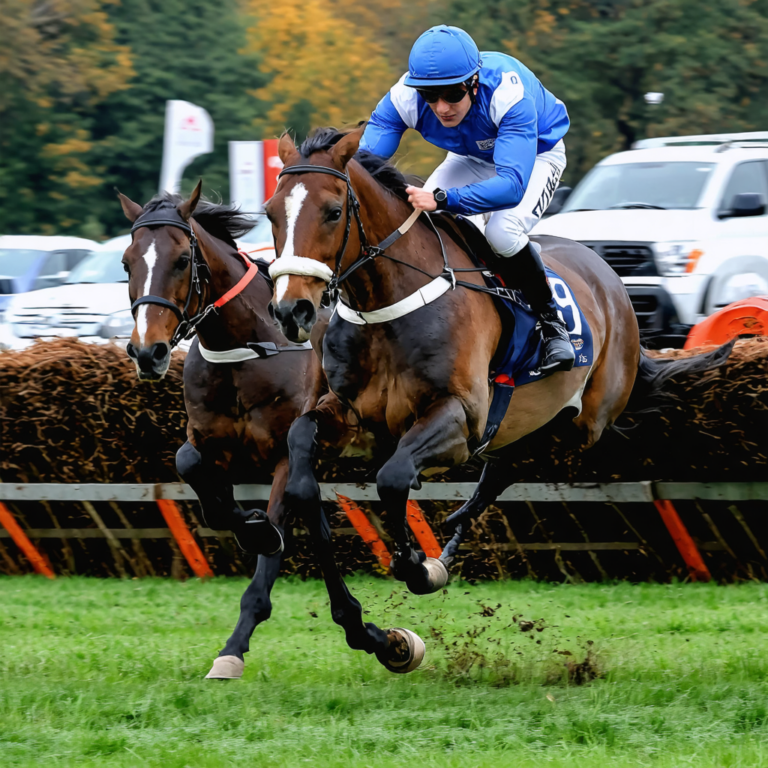
British horse racing is the global benchmark, and its racecard format is the international industry standard. While it may initially seem like a jumble of numbers and terminology, learning to interpret a standard racecard from platforms like At The Races, Racing Post, Timeform, or Sporting Life will give you all the keys to confidently analyze any race in just a few minutes.
1. The Header: Key Race Details
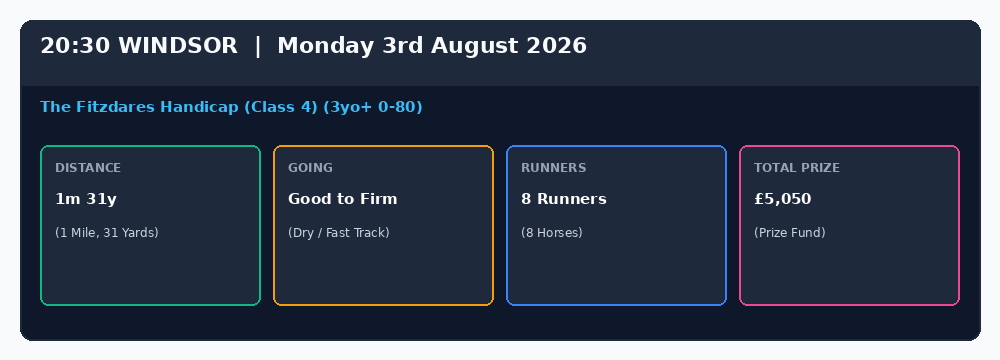
At the top of the card, you’ll find the general context of the event. Using an event at the iconic Windsor Racecourse as an example, the structure is presented exactly as follows:
| Concept | Description and Impact |
|---|---|
| Class | Racing in the UK is divided from Class 1 (elite) to Class 6 (entry level). Class 4 indicates a highly competitive intermediate level. |
| Distance | Expressed in miles (m), furlongs (f, ~200 meters) and yards (y). Example: 1m 31y = 1 mile and 31 yards (~1,637 meters). |
| Going | Key term indicating the firmness of the track. It directly affects the speed and stamina of the horses. |
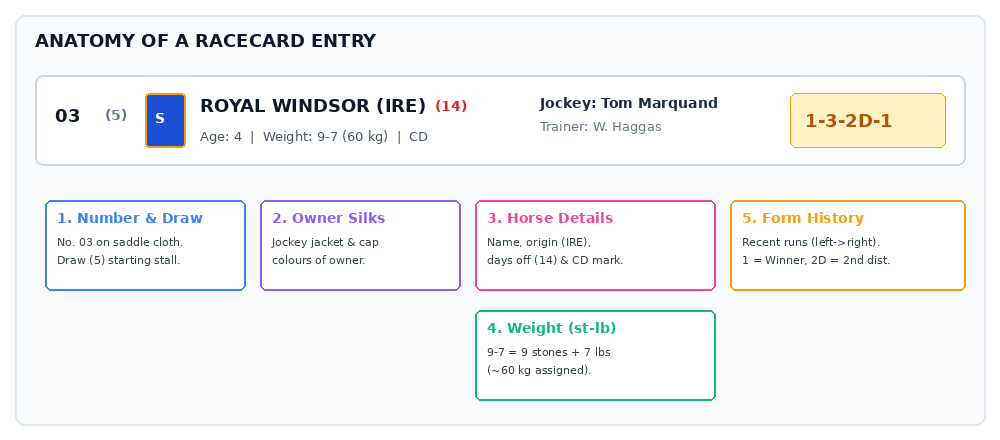
2. Anatomy of a Participant’s Record
Each row represents a competitor. The visual breakdown below adheres to the official terms:
3. Where should you look if you’re a beginner?
3.1. Weight: Stones & Pounds (st-lb) Format
On the cards from the United Kingdom and Ireland, the assigned weight is not expressed in kilograms but in the imperial system: Stones (st) and Pounds (lb) (1 stone = 14 lbs ≈ 6.35 kg).
• Example: 9-7 equals 9 stones and 7 pounds (approx. 60 kg).
• In handicap racing, the best horses are given more weight to level the playing field.
3.2. Official Rating (OR): The Official Rating of the Horse
The Official Rating (OR) is the numerical score assigned to each horse by the official handicappers of the racing authority (such as the British Horseracing Authority). This number measures the exact level of performance and quality of the horse in relation to the rest of the racing population.
Why is it essential and what does it mean for a beginner?
- Regulates weight in handicap races: In handicap races, the OR directly determines how many pounds (lbs) the horse will carry in the saddle. If Horse A has an OR of 75 and Horse B has an OR of 70, Horse A will carry 5 pounds more weight to even the odds.
- Measures progression or decline: If the horse’s OR has steadily increased in its recent performances (e.g., from 65 to 72), it means the horse is currently improving. If the OR decreases, the judges consider that it is losing its form.
3.3. History of Forms and Key Letters
Displays the sequence of recent results for the horse (read from right to left, with the rightmost position being the most recent race):
| Code / Abbreviation | Meaning |
|---|---|
| 1, 2, 3… | Final position in the race. ‘0’ indicates that he finished in tenth place or lower. |
| C (Course) | The horse has previously won at this same racetrack. |
| D (Distance) | The horse has previously won at this exact same distance. |
| CD (Course & Distance) | He has won previously at this same racetrack and at this same distance. |
| BF (Beaten Favourite) | In his last race he was the favorite in the betting but he failed to win. |
| F / PU / UR | F (Fell), PU (Pulled Up), UR (Unseated Rider). |
3.3. Horse’s Starting Box and Origin
• Draw: Number in parentheses next to the racing number. On tracks with tight corners like Windsor, starting from inside pit boxes (Low Draw) can be a significant advantage.
• Origin of the horse: Three-letter code after the name: (IRE) Ireland, (GB) Great Britain, (FR) France, (USA) United States.
4. Practical Summary for Your First Reading
💡 THREE GOLDEN RULES FOR THE BEGINNER:
1. Look for the combination ‘CD’: A horse with ‘CD’ on its record has shown that it adapts to both the current racetrack and the distance of the test.
2. Check for compatibility with the terrain (Going): Check that the horse’s previous best results were on a similar terrain to today’s (e.g., Good to Firm).
3. The rest factor: The number in parentheses next to the name (e.g., (14)) indicates the number of days since its last competition. An interval between 14 and 45 days is generally considered optimal. If the term “break” appears, it means the horse has had an extended rest. Also, check the card for any mention of “Wind Surgery,” which indicates the horse has had an operation to improve its breathing.