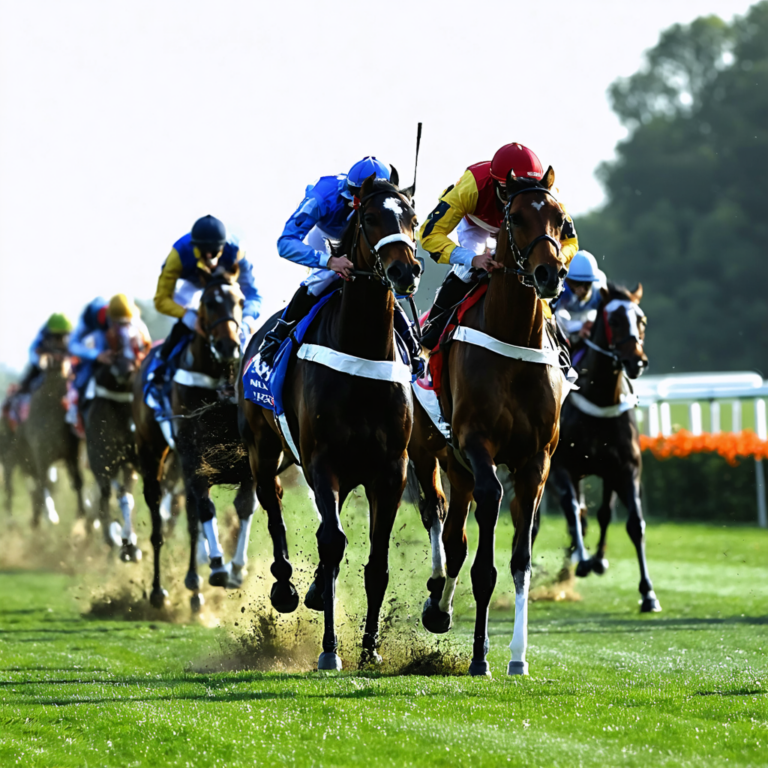
This guide brings together the key terms most commonly used in the world of horse racing. Designed especially for beginners, this glossary makes it easy to understand racecards, types of bets, and the jargon commonly used by commentators and fans.
Race Classification and Terms
Official Rating (OR)
The official rating given by the judges (handicappers) to each horse. It serves to measure its level and determine the weight it will carry in handicap races.
Class (Cl)
Organizational division of races according to the quality of the participants. In the United Kingdom and Ireland, they range from Class 6 (entry level or lower quality) to Class 1 (world elite races such as Listed races and Groups 1, 2 and 3).
Handicap (Hcp)
A type of race in which horses carry different weights in the saddle to equalize their theoretical odds of winning. The higher the odds, the greater the weight assigned.
Going
The condition of the track or grass on which the race takes place directly affects performance, depending on each horse’s preferences:
- Hard / Firm: Very hard or fast terrain.
- Good: Ideal or perfect land.
- Soft / Heavy: Soft ground or soft mud due to rain.
Distance / Furlong
Standard unit of distance in racing in the English-speaking world. A furlong is exactly 220 yards (approximately 201 meters). A mile is equal to 8 furlongs.
Racecard terms
Form
The sequence of numbers and letters next to the horse’s name summarizes its recent positions. For example, 12-301 indicates its most recent results. Remember that the sequence is read from right to left; that is, in this example, the horse won its last race and finished tenth or worse in the previous one. The symbols – and / that you will see on racecards indicate that the horse has had a very long break, usually between seasons.
Weight (Wgt)
The total weight (in stones and pounds, e.g., 9-7 = 9 stones and 7 pounds) that the horse must carry in the race, including the jockey and the lead-weighted saddle. Sometimes, you will see a number in parentheses after the jockey’s name. This indicates that you must subtract that amount in pounds from the horse’s weight, as it is an amateur jockey.
Jockey & Trainer
The Jockey is the professional rider who pilots the horse in the race, while the Trainer is the person in charge of the animal’s daily physical and tactical preparation.
Draw
The starting gate number, assigned by lottery, is the starting draw from which the horse begins in flat races. At certain racetracks and distances, some draws have an advantage. Look at the racecard; it usually indicates this important detail. If it says “high,” the higher draws will have an advantage in that race. Conversely, if it says “low,” the lower draws will have that advantage. If it says “none,” then no draws have an advantage in that race.
Betting and Market Concepts
Odds
The payout or profit offered by a bet. These are usually expressed in fractional (e.g., 3/1), decimal (e.g., 4.00), or American format (+300).
SP (Starting Price)
The official price or odds at which a horse is quoted at the exact moment the race starts.
Win & Each-Way (EW)
Main types of bets:
- Win: Single bet that the horse will cross the finish line in first position.
- Each-Way (Ganador y Colocado): A double bet where half the amount goes to the horse winning and the other half to it finishing in the top positions (e.g., 2nd, 3rd or 4th depending on the race).
Favorite
The horse that is quoted at the lowest odds on the market because it theoretically has the highest probability of winning the race (marked as F on the chips).
Summary Table of Common Abbreviations
| Abbreviation | Full Term | Meaning |
| OR | Official Rating | Quality rating assigned by handicappers. |
| F | Fell / Favourite | In the history card: fell off the fence. In the market: the favorite. |
| P / PU | Pulled Up | The jockey stopped the horse and it did not complete the race.. |
| CD | Course & Distance | The horse has previously won at that same racetrack and distance.. |
| BF | Beaten Favourite | The horse was the favorite in its last race but was defeated. |